CORROGO - I gather together, I strengthen, I forge into one.
CORROGO - I gather together, I strengthen, I forge into one.
Map the living world together.
Map the living world together.
01 Overview
01 Overview
CORROGO At its core, it's building a real-world exploration app think Pokémon Go, but instead of catching fictional creatures, you're going outside, recording real birds, collecting real data, and contributing to actual science.
A real-world exploration app starting with birds. The big idea is: you go outside, record bird sounds and sightings, that data goes into a scientific network that helps researchers track biodiversity, migration, and ecological health.
CORROGO At its core, it's building a real-world exploration app think Pokémon Go, but instead of catching fictional creatures, you're going outside, recording real birds, collecting real data, and contributing to actual science. A real-world exploration app starting with birds. The big idea is: you go outside, record bird sounds and sightings, that data goes into a scientific network that helps researchers track biodiversity, migration, and ecological health.
02 Why birds first
02 Why birds first
Birds are perfect as a starting point they have sounds (easy to record), they move across the whole planet. The market is proven and hungry for something better.
Birds are perfect as a starting point they have sounds (easy to record), they move across the whole planet. The market is proven and hungry for something better.
There are currently 96 million Americans who identify as birders that's more than one in three adults. The industry generates $107.6 billion annually in the US alone, which is roughly six times the total revenue of the NFL. The average birder spends $2,188 per year on equipment, trips, and related costs.
The Cornell Lab of Ornithology's app Merlin Bird ID has been downloaded 23 million times and had 12 million active users in 2024 alone 7.5 million of them first-time users. eBird, the bird observation database, crossed 2 billion cumulative observations in 2025. This tells you the appetite for birding apps and citizen science is already massive and growing fast.
So CORROGO isn't trying to create a market from scratch. It's trying to capture and upgrade a market that already exists and is underserved by fragmented, purely utility-focused tools.
There are currently 96 million Americans who identify as birders that's more than one in three adults. The industry generates $107.6 billion annually in the US alone, which is roughly six times the total revenue of the NFL. The average birder spends $2,188 per year on equipment, trips, and related costs.
The Cornell Lab of Ornithology's app Merlin Bird ID has been downloaded 23 million times and had 12 million active users in 2024 alone 7.5 million of them first-time users. eBird, the bird observation database, crossed 2 billion cumulative observations in 2025. This tells you the appetite for birding apps and citizen science is already massive and growing fast.
So CORROGO isn't trying to create a market from scratch. It's trying to capture and upgrade a market that already exists and is underserved by fragmented, purely utility-focused tools.
To take this further with a scientific lens
Birds navigate using a quantum effect called magnetoreception there is a protein in their retinas called CRY4 that may allow them to literally see the Earth's magnetic field as a visual overlay. This is quantum biology happening inside a living creature. This is "Layer 0" of the CORROGO technology stack the sub-physical navigation channel.
Birds produce sound through a syrinx, which is a dual-oscillator acoustic transmitter. Unlike human vocal cords which have one oscillator, birds have two independent ones, which is why some species can produce two notes simultaneously. This is nature's equivalent of a dual-channel broadcast antenna, evolved and optimized over 150 million years.
The intersection of these biological facts with quantum photonics, mesh networking, and frequency research is the core intellectual territory of CORROGO. We're not just building an app. We're genuinely interested in what birds can teach us about physics, communication, and intelligence.
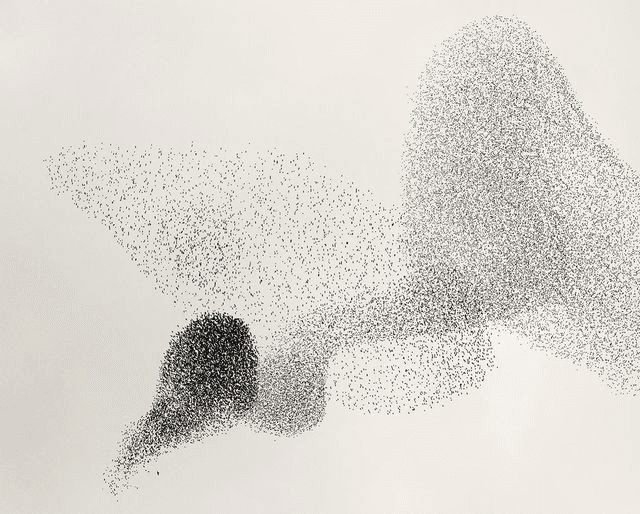
Below is a photograph of a starling murmuration
To take this further with a scientific lens
Birds navigate using a quantum effect called magnetoreception there is a protein in their retinas called CRY4 that may allow them to literally see the Earth's magnetic field as a visual overlay. This is quantum biology happening inside a living creature. This is "Layer 0" of the CORROGO technology stack the sub-physical navigation channel.
Birds produce sound through a syrinx, which is a dual-oscillator acoustic transmitter. Unlike human vocal cords which have one oscillator, birds have two independent ones, which is why some species can produce two notes simultaneously. This is nature's equivalent of a dual-channel broadcast antenna, evolved and optimized over 150 million years.
The intersection of these biological facts with quantum photonics, mesh networking, and frequency research is the core intellectual territory of CORROGO. We're not just building an app. We're genuinely interested in what birds can teach us about physics, communication, and intelligence.
Below is a photograph of a starling murmuration
03 The four arms of the company
03 The four arms of the company
The first is a non-profit focused on community outreach, awareness, and sustainability. This arm produces content, runs education seminars, purchases and conserves land, and drives social media awareness. It is like wanting to be "like Red Bull with the content" meaning content so compelling that people encounter it and are pulled into the world of birding without even realizing it.
The second is a research and commercial operations arm. This covers expedition planning, the software platform, hardware for field use (trekking gear, sighting and sensing equipment), and conservation equipment both biological and non-biological including landscaping tools for habitat restoration.
The third is a deep tech arm focused on the scientific frontiers the project is exploring: mesh networking (the bird relay system), data compression, flight and aerodynamics research (relating to how birds fly and what that tells us about physics), and photonics (relating to how birds navigate using quantum effects in their eyes more on that below).
The fourth is a retail storefront, both physical and online, selling gear relevant to the CORROGO community.
The first is a non-profit focused on community outreach, awareness, and sustainability. This arm produces content, runs education seminars, purchases and conserves land, and drives social media awareness. It is like wanting to be "like Red Bull with the content" meaning content so compelling that people encounter it and are pulled into the world of birding without even realizing it.
The second is a research and commercial operations arm. This covers expedition planning, the software platform, hardware for field use (trekking gear, sighting and sensing equipment), and conservation equipment both biological and non-biological including landscaping tools for habitat restoration.
The third is a deep tech arm focused on the scientific frontiers the project is exploring: mesh networking (the bird relay system), data compression, flight and aerodynamics research (relating to how birds fly and what that tells us about physics), and photonics (relating to how birds navigate using quantum effects in their eyes more on that below).
The fourth is a retail storefront, both physical and online, selling gear relevant to the CORROGO community.
04 App (Chirp)
04 App (Chirp)
It is the primary commercial vehicle and the entry point for most users.
It is the primary commercial vehicle and the entry point for most users.
The user identity is as a researcher, not a player.
The user identity is as a researcher, not a player.
It has a social layer (find your "pact" of fellow birders), a gamification layer (collect species, earn tiers, climb leaderboards), a trust/science layer (your recordings get verified and fed to real research), and eventually an economy layer (gear marketplace, premium features).
It has a social layer (find your "pact" of fellow birders), a gamification layer (collect species, earn tiers, climb leaderboards), a trust/science layer (your recordings get verified and fed to real research), and eventually an economy layer (gear marketplace, premium features).
How it works from a user's perspective:
How it works from a user's perspective:
You open the app and see a live map not a social feed. The map shows nearby species zones, recent verified bird sightings from other users (no exact user locations, only findings), habitat overlays, and mission trails. It feels like a field command center, not a content app.
When you spot or hear a bird, you tap once to open a capture flow: Sound, Sight, Trace, or Group Report. Sound is the hero mode because audio recording is lower friction than photography you can do it without disturbing the bird, without perfect lighting, without great camera gear.
Every recording you make gets attached to a geotag, a timestamp, and goes through AI-assisted identification. The community can verify or correct it. Over time your contributions build a "trust score" and a researcher profile your identity on the platform is as a scientist, not just a hobbyist.
You collect species in a personal "table of discoveries." Rarer birds earn you higher tiers. You can join "pacts" small groups of birders who go on expeditions together, share findings, and collaborate. There's a social feed, but it shows discoveries, expedition logs, and rare finds not selfies and vanity posts.
Design wise: deep blacks, mineral blues, moss greens, signal golds, subtle radar pulses. The emotional tone is less cartoon than Pokémon Go and more "beautiful field command center." Serious but cinematic.
You open the app and see a live map not a social feed. The map shows nearby species zones, recent verified bird sightings from other users (no exact user locations, only findings), habitat overlays, and mission trails. It feels like a field command center, not a content app.
When you spot or hear a bird, you tap once to open a capture flow: Sound, Sight, Trace, or Group Report. Sound is the hero mode because audio recording is lower friction than photography you can do it without disturbing the bird, without perfect lighting, without great camera gear.
Every recording you make gets attached to a geotag, a timestamp, and goes through AI-assisted identification. The community can verify or correct it. Over time your contributions build a "trust score" and a researcher profile your identity on the platform is as a scientist, not just a hobbyist.
You collect species in a personal "table of discoveries." Rarer birds earn you higher tiers. You can join "pacts" small groups of birders who go on expeditions together, share findings, and collaborate. There's a social feed, but it shows discoveries, expedition logs, and rare finds not selfies and vanity posts.
Design wise: deep blacks, mineral blues, moss greens, signal golds, subtle radar pulses. The emotional tone is less cartoon than Pokémon Go and more "beautiful field command center." Serious but cinematic.
Onboarding self-categorises users into six levels:
Onboarding self-categorises users into six levels:
Curious
Learning
Involved
Enthusiastic
All-in
Literally a Bird
Curious
Learning
Involved
Enthusiastic
All-in
Literally a Bird
The user journey loop
The user journey loop
See content- Social media
Join app- Onboard to Chirp
Go outside- Record birds
Feed science- Data to research
See content- Social media
Join app- Onboard to Chirp
Go outside- Record birds
Feed science- Data to research
05 The Core Problem CORROGO is Solving
05 The Core Problem CORROGO is Solving
Right now, birding is split across many disconnected tools: Merlin for identification, eBird for logging sightings, iNaturalist for broader nature observation, separate apps for competitions, separate forums for community. None of them combine the social pull of something like Instagram or TikTok with the real-world action of Pokémon Go with the scientific seriousness of a research platform.
CORROGO's position is: be the unified experience layer. One app that gives you the emotional pull to go outside, the social reward when you do, the gamification to keep you coming back, and the scientific infrastructure that makes your contributions actually matter.
Right now, birding is split across many disconnected tools: Merlin for identification, eBird for logging sightings, iNaturalist for broader nature observation, separate apps for competitions, separate forums for community. None of them combine the social pull of something like Instagram or TikTok with the real-world action of Pokémon Go with the scientific seriousness of a research platform.
CORROGO's position is: be the unified experience layer. One app that gives you the emotional pull to go outside, the social reward when you do, the gamification to keep you coming back, and the scientific infrastructure that makes your contributions actually matter.
06 CHIRP Device Specification — The Hardware Product Brief
06 CHIRP Device Specification — The Hardware Product Brief
The framing device: every existing product on the market including the $5,499 Swarovski AX Visio only answers "what species is that?" Chirp answers "what is that bird saying, and can we say something back?" The comparison lists the Swarovski AX Visio, MataXplore Solvia, and Chirp side by side across 15 capability dimensions. Every row where the competitors have "No" maps to a row where Chirp has a detailed answer.
The optics module is built on a genuine premium foundation — 10x42 apochromatic ED glass, phase-corrected roof prisms, which means without any electronics active, it is a world-class pair of binoculars. "You're looking at a 160-million-year-old dinosaur; the image should be worthy of the subject." On top of the optical experience sits a 48-megapixel sensor aligned to the optical path via beamsplitter, allowing simultaneous analog viewing and digital capture. 4K video at 60fps for flight pattern analysis. Electronic image stabilization. Digital zoom to 60x. And a micro-OLED or waveguide AR display overlaid on the optical view, non-intrusive, activating on demand, showing species ID, spectrograms, individual bird tags, compass bearings, behavioral annotations, and mesh network activity.
The audio module is the core differentiator. Four to six MEMS microphones in a phased array around the housing allow beamforming the mic array focuses audio capture in the direction you're pointing the binoculars, isolating a single bird from the surrounding chorus. Capture at 96kHz, double standard quality, to preserve ultrasonic harmonics. An optional clip-on parabolic reflector attachment provides 20-30 decibels of additional directional gain for recording individual birds at 100+ meters with clean signal. Bone conduction transducers in the headband deliver amplified, frequency-shaped audio without blocking ambient soun you hear both the real environment and the boosted clarified bird audio simultaneously. The frequency shaping boosts the 2-8 kHz range where most songbird vocalizations concentrate. The directional speaker small or optionally an ultrasonic parametric array for a tight beam is the dialog channel. It's how the system talks back.
The compute module runs multiple AI systems simultaneously on-device: BirdNET for audio species ID with under 1 second latency, YOLO bird detection for visual identification under 2 seconds, real-time spectrogram generation under 50 milliseconds for the AR overlay, individual re-identification embedding comparison under 500 milliseconds, and behavioral classification per segment. The device has 256GB of local storage, providing 20-40 hours of continuous dual-stream recording. LoRa transceiver makes every Chirp device a mesh node with potentially 10+ kilometer range in open terrain.
The framing device: every existing product on the market including the $5,499 Swarovski AX Visio only answers "what species is that?" Chirp answers "what is that bird saying, and can we say something back?" The comparison lists the Swarovski AX Visio, MataXplore Solvia, and Chirp side by side across 15 capability dimensions. Every row where the competitors have "No" maps to a row where Chirp has a detailed answer.
The optics module is built on a genuine premium foundation — 10x42 apochromatic ED glass, phase-corrected roof prisms, which means without any electronics active, it is a world-class pair of binoculars. "You're looking at a 160-million-year-old dinosaur; the image should be worthy of the subject." On top of the optical experience sits a 48-megapixel sensor aligned to the optical path via beamsplitter, allowing simultaneous analog viewing and digital capture. 4K video at 60fps for flight pattern analysis. Electronic image stabilization. Digital zoom to 60x. And a micro-OLED or waveguide AR display overlaid on the optical view, non-intrusive, activating on demand, showing species ID, spectrograms, individual bird tags, compass bearings, behavioral annotations, and mesh network activity.
The audio module is the core differentiator. Four to six MEMS microphones in a phased array around the housing allow beamforming the mic array focuses audio capture in the direction you're pointing the binoculars, isolating a single bird from the surrounding chorus. Capture at 96kHz, double standard quality, to preserve ultrasonic harmonics. An optional clip-on parabolic reflector attachment provides 20-30 decibels of additional directional gain for recording individual birds at 100+ meters with clean signal. Bone conduction transducers in the headband deliver amplified, frequency-shaped audio without blocking ambient soun you hear both the real environment and the boosted clarified bird audio simultaneously. The frequency shaping boosts the 2-8 kHz range where most songbird vocalizations concentrate. The directional speaker small or optionally an ultrasonic parametric array for a tight beam is the dialog channel. It's how the system talks back.
The compute module runs multiple AI systems simultaneously on-device: BirdNET for audio species ID with under 1 second latency, YOLO bird detection for visual identification under 2 seconds, real-time spectrogram generation under 50 milliseconds for the AR overlay, individual re-identification embedding comparison under 500 milliseconds, and behavioral classification per segment. The device has 256GB of local storage, providing 20-40 hours of continuous dual-stream recording. LoRa transceiver makes every Chirp device a mesh node with potentially 10+ kilometer range in open terrain.
The software architecture builds through five layers.Unified Hard-Asset Management:
The capture engine runs everything continuously.
The species detection layer identifies what's there.
The individual re-identification layer builds vocal fingerprints for specific birds over time and tracks social relationships which individuals are consistently detected together, which respond to each other's calls, building a social graph of the local bird community.
The behavioral decode layer goes beyond species to call function: alarm for aerial predator, alarm for ground predator, contact call, recruitment, territorial, mate attraction, food discovery, distress, juvenile begging, flock coordination.
The active dialog layer proposes synthetic calls based on the current model's uncertainty, the human approves, the bird responds, and the system learns from the response in a closed loop.
The software architecture builds through five layers.Unified Hard-Asset Management:
The capture engine runs everything continuously.
The species detection layer identifies what's there.
The individual re-identification layer builds vocal fingerprints for specific birds over time and tracks social relationships which individuals are consistently detected together, which respond to each other's calls, building a social graph of the local bird community.
The behavioral decode layer goes beyond species to call function: alarm for aerial predator, alarm for ground predator, contact call, recruitment, territorial, mate attraction, food discovery, distress, juvenile begging, flock coordination.
The active dialog layer proposes synthetic calls based on the current model's uncertainty, the human approves, the bird responds, and the system learns from the response in a closed loop.
The five developnment phase run from
Phase 1 (smart binoculars with AI shipping now) through
Phase 2 (semantic decode and individual re-ID),
Phase 3 (active dialog first real two-way communication),
Phase 4 (quantum magnetometer sensors, UV cameras, polarization sensors extending human perception into avian-native signal domains), and
Phase 5 (the full human-bird mesh where every Chirp user and every detected bird are peers on one interlinked network called Tapestry).
The five developnment phase run from
Phase 1 (smart binoculars with AI shipping now) through
Phase 2 (semantic decode and individual re-ID),
Phase 3 (active dialog first real two-way communication),
Phase 4 (quantum magnetometer sensors, UV cameras, polarization sensors extending human perception into avian-native signal domains), and
Phase 5 (the full human-bird mesh where every Chirp user and every detected bird are peers on one interlinked network called Tapestry).
The name Chirp encodes the full concept: it is the bird's signal unit, it is also the name of LoRa's modulation technique (chirp spread spectrum) the same frequency sweep birds invented millions of years before the semiconductor company Semtech did, and it is onomatopoeic the sound itself crossing the language barrier by being the thing it names.
The name Chirp encodes the full concept: it is the bird's signal unit, it is also the name of LoRa's modulation technique (chirp spread spectrum) the same frequency sweep birds invented millions of years before the semiconductor company Semtech did, and it is onomatopoeic the sound itself crossing the language barrier by being the thing it names.
Why the data matters
This is what separates CORROGO from just being another app. Every recording fed into the system becomes part of a real scientific dataset. eBird's 2 billion observations have been used in over 1,180 peer-reviewed scientific papers. That's what crowd-sourced bird data can do at scale.
CORROGO wants to build on that. The trust layer of the platform geotag, timestamp, device signature, AI confidence score, community verification means the data isn't just raw noise. It's structured, verified, and scientifically usable. The term used in the documents is "DeSci" Decentralized Science meaning open data, transparent validation, and broader public participation in research that has traditionally been locked behind academic institutions.
A birder in your city recording a lesser flameback woodpecker contributes a data point that could feed into a migration study at Cornell, a conservation decision about forest protection in your city, or a biodiversity credit market that assigns economic value to healthy ecosystems.
Why the data matters
This is what separates CORROGO from just being another app. Every recording fed into the system becomes part of a real scientific dataset. eBird's 2 billion observations have been used in over 1,180 peer-reviewed scientific papers. That's what crowd-sourced bird data can do at scale.
CORROGO wants to build on that. The trust layer of the platform geotag, timestamp, device signature, AI confidence score, community verification means the data isn't just raw noise. It's structured, verified, and scientifically usable. The term used in the documents is "DeSci" Decentralized Science meaning open data, transparent validation, and broader public participation in research that has traditionally been locked behind academic institutions.
A birder in your city recording a lesser flameback woodpecker contributes a data point that could feed into a migration study at Cornell, a conservation decision about forest protection in your city, or a biodiversity credit market that assigns economic value to healthy ecosystems.
07 The Biological Relay
07 The Biological Relay
The idea is to attach tiny, lightweight transmitters to birds specifically birds that migrate long distances. These tags (currently around 2.5–3 grams, solar-powered) carry GPS, temperature sensors, barometers, humidity sensors, and a small radio. As the bird flies, the tag continuously collects environmental data. When the bird comes within range of a Chirp station (a small device someone has set up in their garden or at a nature reserve), the tag offloads all its stored data wirelessly in seconds.
What makes this remarkable is the store-and-forward model. The bird doesn't need continuous connectivity. It just collects data all day, and whenever it passes near any CORROGO infrastructure even another tagged bird it dumps its payload. A Blackpoll Warbler flying nonstop from Venezuela to Cape Cod for 72 hours at 6,000 meters altitude collects atmospheric data that no weather balloon, satellite, or ocean buoy has ever captured along that exact route. When it lands and passes near a Chirp station in someone's garden, 4.2 kilobytes of data 72 GPS fixes, atmospheric readings every 5 minutes, the bird's own health telemetry offloads in under 2 seconds.
This to similar UUCP, the way the early internet physically transported data on magnetic tapes between universities. The latency is days or weeks rather than milliseconds, but for environmental data that doesn't need to be real-time, that's perfectly fine.
There is real infrastructure already being built for this. The ICARUS project (International Cooperation for Animal Research Using Space) at the Max Planck Institute launched its first CubeSat receiver in November 2025 aboard a SpaceX Falcon 9 rocket. It plans to have near-global coverage by 2027. The long-term goal is 100,000 animal sentinels from 500 species delivering updated data every half hour. CORROGO wants to integrate with and build on top of this.
The idea is to attach tiny, lightweight transmitters to birds specifically birds that migrate long distances. These tags (currently around 2.5–3 grams, solar-powered) carry GPS, temperature sensors, barometers, humidity sensors, and a small radio. As the bird flies, the tag continuously collects environmental data. When the bird comes within range of a Chirp station (a small device someone has set up in their garden or at a nature reserve), the tag offloads all its stored data wirelessly in seconds.
What makes this remarkable is the store-and-forward model. The bird doesn't need continuous connectivity. It just collects data all day, and whenever it passes near any CORROGO infrastructure even another tagged bird it dumps its payload. A Blackpoll Warbler flying nonstop from Venezuela to Cape Cod for 72 hours at 6,000 meters altitude collects atmospheric data that no weather balloon, satellite, or ocean buoy has ever captured along that exact route. When it lands and passes near a Chirp station in someone's garden, 4.2 kilobytes of data 72 GPS fixes, atmospheric readings every 5 minutes, the bird's own health telemetry offloads in under 2 seconds.
This to similar UUCP, the way the early internet physically transported data on magnetic tapes between universities. The latency is days or weeks rather than milliseconds, but for environmental data that doesn't need to be real-time, that's perfectly fine.
There is real infrastructure already being built for this. The ICARUS project (International Cooperation for Animal Research Using Space) at the Max Planck Institute launched its first CubeSat receiver in November 2025 aboard a SpaceX Falcon 9 rocket. It plans to have near-global coverage by 2027. The long-term goal is 100,000 animal sentinels from 500 species delivering updated data every half hour. CORROGO wants to integrate with and build on top of this.
Ethical boundaries
No tag may exceed 3% of a bird's body weight, attachment methods must follow published protocols, and any tagging program must have independent animal welfare oversight. The philosophical position is that if birds carry human data, the humans owe conservation outcomes in return.
Ethical boundaries
No tag may exceed 3% of a bird's body weight, attachment methods must follow published protocols, and any tagging program must have independent animal welfare oversight. The philosophical position is that if birds carry human data, the humans owe conservation outcomes in return.
08 The Mesh Network — Reticulum
08 The Mesh Network — Reticulum
The entire technical infrastructure runs on Reticulum — an open-source cryptographic networking protocol with specific properties that align with CORROGO’s values:
No central authority — cannot be shut down by any government or corporation
Identity derived from cryptographic keys (like Bitcoin wallets, but for communication)
Transport-agnostic — works over LoRa, WiFi, Bluetooth, satellite, or any medium that carries bits
Delay-tolerant by design — latencies of hours to days are handled natively
Encrypted by default — there is no unencrypted packet format
Public domain — anyone can use, modify, or build on it
The entire technical infrastructure runs on Reticulum — an open-source cryptographic networking protocol with specific properties that align with CORROGO’s values:
No central authority — cannot be shut down by any government or corporation
Identity derived from cryptographic keys (like Bitcoin wallets, but for communication)
Transport-agnostic — works over LoRa, WiFi, Bluetooth, satellite, or any medium that carries bits
Delay-tolerant by design — latencies of hours to days are handled natively
Encrypted by default — there is no unencrypted packet format
Public domain — anyone can use, modify, or build on it
The chirp mesh operates across five transport tiers simultaneously:
LoRa radio for detection events
Bluetooth for close-range device exchanges
WiFi for bulk upload
Cellular/satellite for remote connectivity, and
Biological relay via tagged birds.
The chirp mesh operates across five transport tiers simultaneously:
LoRa radio for detection events
Bluetooth for close-range device exchanges
WiFi for bulk upload
Cellular/satellite for remote connectivity, and
Biological relay via tagged birds.
09 The Economic model
09 The Economic model
The economic model is an inversion of conventional telecommunications. The global telecom industry earns $1.8 trillion annually — a tax on human connection. Chirp replaces that with a system where the cost of communication is ecological stewardship rather than a subscription fee.
Revenue comes not from subscriptions but from biodiversity credit verification. Corporations required to report on their nature-related financial risks (under emerging TNFD frameworks) need verified biodiversity data. The cryptographically signed measurement data the Chirp mesh generates as a byproduct of its communication function is exactly what those markets need. That revenue funds station deployment, bio-logger programmes, and habitat restoration.
The network’s quality of service becomes a real-time indicator of environmental health.
The economic model is an inversion of conventional telecommunications. The global telecom industry earns $1.8 trillion annually — a tax on human connection. Chirp replaces that with a system where the cost of communication is ecological stewardship rather than a subscription fee.
Revenue comes not from subscriptions but from biodiversity credit verification. Corporations required to report on their nature-related financial risks (under emerging TNFD frameworks) need verified biodiversity data. The cryptographically signed measurement data the Chirp mesh generates as a byproduct of its communication function is exactly what those markets need. That revenue funds station deployment, bio-logger programmes, and habitat restoration.
The network’s quality of service becomes a real-time indicator of environmental health.
Network gets denser
Network gets denser
More ecology is monitored
More ecology is monitored
More credits are generated
More credits are generated
More infrastructure is funded
More infrastructure is funded
What this project is not
Not just another birding app — the correct framing is “the interface for experiencing, verifying, and mapping the living world”
Not a crypto-first rewards platform — the DeSci edge is verifiable contribution infrastructure, not token speculation
Not a surveillance system — no user locations are shared, all communication is end-to-end encrypted
Not an extraction machine — if ecological health becomes just an asset class, the project has lost its soul
Not a replacement for being outside — every feature should make people more present to reality, not less
Not a product where markets come first — the governing order is: wonder, participation, truth, stewardship, utility, markets last
What this project is not
Not just another birding app — the correct framing is “the interface for experiencing, verifying, and mapping the living world”
Not a crypto-first rewards platform — the DeSci edge is verifiable contribution infrastructure, not token speculation
Not a surveillance system — no user locations are shared, all communication is end-to-end encrypted
Not an extraction machine — if ecological health becomes just an asset class, the project has lost its soul
Not a replacement for being outside — every feature should make people more present to reality, not less
Not a product where markets come first — the governing order is: wonder, participation, truth, stewardship, utility, markets last
The underlying belief is that the world has lost its focus on nature, on real human connection, on science as something participatory rather than something that happens in labs behind closed doors. CORROGO wants to be the interface that brings people back outside, gives their observations scientific weight, and creates a feedback loop where the more people participate, the more valuable the land with healthy bird populations becomes, and the more incentive there is to protect it.
The underlying belief is that the world has lost its focus on nature, on real human connection, on science as something participatory rather than something that happens in labs behind closed doors. CORROGO wants to be the interface that brings people back outside, gives their observations scientific weight, and creates a feedback loop where the more people participate, the more valuable the land with healthy bird populations becomes, and the more incentive there is to protect it.
Starting point vs Long term vision
Phase 1 is audio-first bird logging - the sound capture app, species ID, discovery table, rarity maps, streaks, and local missions. Success is measured by weekly capture habit and the first trusted dataset.
Phase 2 adds the social field network - pacts, expedition scheduling, local chat, route sharing, collaborative missions. Success is group retention and referral growth.
Phase 3 builds the trust engine - AI review, provenance scoring, verification tiers, expert validation. This is what makes the data scientifically credible and therefore commercially valuable.
Phase 4 introduces the economy layer - pro subscriptions, rare-alert intelligence, premium map overlays, gear marketplace, field hardware sales.
Phase 5 expands beyond birds to plants, fungi, rocks, minerals, soil, and eventually broader reality mapping. This is the "world intelligence map" vision coming into full form.
Starting point vs Long term vision
Phase 1 is audio-first bird logging - the sound capture app, species ID, discovery table, rarity maps, streaks, and local missions. Success is measured by weekly capture habit and the first trusted dataset.
Phase 2 adds the social field network - pacts, expedition scheduling, local chat, route sharing, collaborative missions. Success is group retention and referral growth.
Phase 3 builds the trust engine - AI review, provenance scoring, verification tiers, expert validation. This is what makes the data scientifically credible and therefore commercially valuable.
Phase 4 introduces the economy layer - pro subscriptions, rare-alert intelligence, premium map overlays, gear marketplace, field hardware sales.
Phase 5 expands beyond birds to plants, fungi, rocks, minerals, soil, and eventually broader reality mapping. This is the "world intelligence map" vision coming into full form.
CORROGO - I gather together, I strengthen, I forge into one.
Map the living world together.
01 Overview
CORROGO At its core, it's building a real-world exploration app think Pokémon Go, but instead of catching fictional creatures, you're going outside, recording real birds, collecting real data, and contributing to actual science.
A real-world exploration app starting with birds. The big idea is: you go outside, record bird sounds and sightings, that data goes into a scientific network that helps researchers track biodiversity, migration, and ecological health.
02 Why birds first
Birds are perfect as a starting point they have sounds (easy to record), they move across the whole planet. The market is proven and hungry for something better.
There are currently 96 million Americans who identify as birders that's more than one in three adults. The industry generates $107.6 billion annually in the US alone, which is roughly six times the total revenue of the NFL. The average birder spends $2,188 per year on equipment, trips, and related costs.
The Cornell Lab of Ornithology's app Merlin Bird ID has been downloaded 23 million times and had 12 million active users in 2024 alone 7.5 million of them first-time users. eBird, the bird observation database, crossed 2 billion cumulative observations in 2025. This tells you the appetite for birding apps and citizen science is already massive and growing fast.
So CORROGO isn't trying to create a market from scratch. It's trying to capture and upgrade a market that already exists and is underserved by fragmented, purely utility-focused tools.
To take this further with a scientific lens
Birds navigate using a quantum effect called magnetoreception there is a protein in their retinas called CRY4 that may allow them to literally see the Earth's magnetic field as a visual overlay. This is quantum biology happening inside a living creature. This is "Layer 0" of the CORROGO technology stack the sub-physical navigation channel.
Birds produce sound through a syrinx, which is a dual-oscillator acoustic transmitter. Unlike human vocal cords which have one oscillator, birds have two independent ones, which is why some species can produce two notes simultaneously. This is nature's equivalent of a dual-channel broadcast antenna, evolved and optimized over 150 million years.
The intersection of these biological facts with quantum photonics, mesh networking, and frequency research is the core intellectual territory of CORROGO. We're not just building an app. We're genuinely interested in what birds can teach us about physics, communication, and intelligence.
Below is a photograph of a starling murmuration
03 The four arms of the company
The first is a non-profit focused on community outreach, awareness, and sustainability. This arm produces content, runs education seminars, purchases and conserves land, and drives social media awareness. It is like wanting to be "like Red Bull with the content" meaning content so compelling that people encounter it and are pulled into the world of birding without even realizing it.
The second is a research and commercial operations arm. This covers expedition planning, the software platform, hardware for field use (trekking gear, sighting and sensing equipment), and conservation equipment both biological and non-biological including landscaping tools for habitat restoration.
The third is a deep tech arm focused on the scientific frontiers the project is exploring: mesh networking (the bird relay system), data compression, flight and aerodynamics research (relating to how birds fly and what that tells us about physics), and photonics (relating to how birds navigate using quantum effects in their eyes more on that below).
The fourth is a retail storefront, both physical and online, selling gear relevant to the CORROGO community.
04 App (Chirp)
It is the primary commercial vehicle and the entry point for most users.
The user identity is as a researcher, not a player.
It has a social layer (find your "pact" of fellow birders), a gamification layer (collect species, earn tiers, climb leaderboards), a trust/science layer (your recordings get verified and fed to real research), and eventually an economy layer (gear marketplace, premium features).
How it works from a user's perspective:
You open the app and see a live map not a social feed. The map shows nearby species zones, recent verified bird sightings from other users (no exact user locations, only findings), habitat overlays, and mission trails. It feels like a field command center, not a content app.
When you spot or hear a bird, you tap once to open a capture flow: Sound, Sight, Trace, or Group Report. Sound is the hero mode because audio recording is lower friction than photography you can do it without disturbing the bird, without perfect lighting, without great camera gear.
Every recording you make gets attached to a geotag, a timestamp, and goes through AI-assisted identification. The community can verify or correct it. Over time your contributions build a "trust score" and a researcher profile your identity on the platform is as a scientist, not just a hobbyist.
You collect species in a personal "table of discoveries." Rarer birds earn you higher tiers. You can join "pacts" small groups of birders who go on expeditions together, share findings, and collaborate. There's a social feed, but it shows discoveries, expedition logs, and rare finds not selfies and vanity posts.
Design wise: deep blacks, mineral blues, moss greens, signal golds, subtle radar pulses. The emotional tone is less cartoon than Pokémon Go and more "beautiful field command center." Serious but cinematic.
Onboarding self-categorises users into six levels:
Curious
Learning
Involved
Enthusiastic
All-in
Literally a Bird
The user journey loop
See content- Social media
Join app- Onboard to Chirp
Go outside- Record birds
Feed science- Data to research
05 The Core Problem CORROGO is Solving
Right now, birding is split across many disconnected tools: Merlin for identification, eBird for logging sightings, iNaturalist for broader nature observation, separate apps for competitions, separate forums for community. None of them combine the social pull of something like Instagram or TikTok with the real-world action of Pokémon Go with the scientific seriousness of a research platform.
CORROGO's position is: be the unified experience layer. One app that gives you the emotional pull to go outside, the social reward when you do, the gamification to keep you coming back, and the scientific infrastructure that makes your contributions actually matter.
06 CHIRP Device Specification — The Hardware Product Brief
The framing device: every existing product on the market including the $5,499 Swarovski AX Visio only answers "what species is that?" Chirp answers "what is that bird saying, and can we say something back?" The comparison lists the Swarovski AX Visio, MataXplore Solvia, and Chirp side by side across 15 capability dimensions. Every row where the competitors have "No" maps to a row where Chirp has a detailed answer.
The optics module is built on a genuine premium foundation — 10x42 apochromatic ED glass, phase-corrected roof prisms, which means without any electronics active, it is a world-class pair of binoculars. "You're looking at a 160-million-year-old dinosaur; the image should be worthy of the subject." On top of the optical experience sits a 48-megapixel sensor aligned to the optical path via beamsplitter, allowing simultaneous analog viewing and digital capture. 4K video at 60fps for flight pattern analysis. Electronic image stabilization. Digital zoom to 60x. And a micro-OLED or waveguide AR display overlaid on the optical view, non-intrusive, activating on demand, showing species ID, spectrograms, individual bird tags, compass bearings, behavioral annotations, and mesh network activity.
The audio module is the core differentiator. Four to six MEMS microphones in a phased array around the housing allow beamforming the mic array focuses audio capture in the direction you're pointing the binoculars, isolating a single bird from the surrounding chorus. Capture at 96kHz, double standard quality, to preserve ultrasonic harmonics. An optional clip-on parabolic reflector attachment provides 20-30 decibels of additional directional gain for recording individual birds at 100+ meters with clean signal. Bone conduction transducers in the headband deliver amplified, frequency-shaped audio without blocking ambient soun you hear both the real environment and the boosted clarified bird audio simultaneously. The frequency shaping boosts the 2-8 kHz range where most songbird vocalizations concentrate. The directional speaker small or optionally an ultrasonic parametric array for a tight beam is the dialog channel. It's how the system talks back.
The compute module runs multiple AI systems simultaneously on-device: BirdNET for audio species ID with under 1 second latency, YOLO bird detection for visual identification under 2 seconds, real-time spectrogram generation under 50 milliseconds for the AR overlay, individual re-identification embedding comparison under 500 milliseconds, and behavioral classification per segment. The device has 256GB of local storage, providing 20-40 hours of continuous dual-stream recording. LoRa transceiver makes every Chirp device a mesh node with potentially 10+ kilometer range in open terrain.
The software architecture builds through five layers.Unified Hard-Asset Management:
The capture engine runs everything continuously.
The species detection layer identifies what's there.
The individual re-identification layer builds vocal fingerprints for specific birds over time and tracks social relationships which individuals are consistently detected together, which respond to each other's calls, building a social graph of the local bird community.
The behavioral decode layer goes beyond species to call function: alarm for aerial predator, alarm for ground predator, contact call, recruitment, territorial, mate attraction, food discovery, distress, juvenile begging, flock coordination.
The active dialog layer proposes synthetic calls based on the current model's uncertainty, the human approves, the bird responds, and the system learns from the response in a closed loop.
The five developnment phase run from
Phase 1 (smart binoculars with AI shipping now) through
Phase 2 (semantic decode and individual re-ID),
Phase 3 (active dialog first real two-way communication),
Phase 4 (quantum magnetometer sensors, UV cameras, polarization sensors extending human perception into avian-native signal domains), and
Phase 5 (the full human-bird mesh where every Chirp user and every detected bird are peers on one interlinked network called Tapestry).
The name Chirp encodes the full concept: it is the bird's signal unit, it is also the name of LoRa's modulation technique (chirp spread spectrum) the same frequency sweep birds invented millions of years before the semiconductor company Semtech did, and it is onomatopoeic the sound itself crossing the language barrier by being the thing it names.
Why the data matters
This is what separates CORROGO from just being another app. Every recording fed into the system becomes part of a real scientific dataset. eBird's 2 billion observations have been used in over 1,180 peer-reviewed scientific papers. That's what crowd-sourced bird data can do at scale.
CORROGO wants to build on that. The trust layer of the platform geotag, timestamp, device signature, AI confidence score, community verification means the data isn't just raw noise. It's structured, verified, and scientifically usable. The term used in the documents is "DeSci" Decentralized Science meaning open data, transparent validation, and broader public participation in research that has traditionally been locked behind academic institutions.
A birder in your city recording a lesser flameback woodpecker contributes a data point that could feed into a migration study at Cornell, a conservation decision about forest protection in your city, or a biodiversity credit market that assigns economic value to healthy ecosystems.
07 The Biological Relay
The idea is to attach tiny, lightweight transmitters to birds specifically birds that migrate long distances. These tags (currently around 2.5–3 grams, solar-powered) carry GPS, temperature sensors, barometers, humidity sensors, and a small radio. As the bird flies, the tag continuously collects environmental data. When the bird comes within range of a Chirp station (a small device someone has set up in their garden or at a nature reserve), the tag offloads all its stored data wirelessly in seconds.
What makes this remarkable is the store-and-forward model. The bird doesn't need continuous connectivity. It just collects data all day, and whenever it passes near any CORROGO infrastructure even another tagged bird it dumps its payload. A Blackpoll Warbler flying nonstop from Venezuela to Cape Cod for 72 hours at 6,000 meters altitude collects atmospheric data that no weather balloon, satellite, or ocean buoy has ever captured along that exact route. When it lands and passes near a Chirp station in someone's garden, 4.2 kilobytes of data 72 GPS fixes, atmospheric readings every 5 minutes, the bird's own health telemetry offloads in under 2 seconds.
This to similar UUCP, the way the early internet physically transported data on magnetic tapes between universities. The latency is days or weeks rather than milliseconds, but for environmental data that doesn't need to be real-time, that's perfectly fine.
There is real infrastructure already being built for this. The ICARUS project (International Cooperation for Animal Research Using Space) at the Max Planck Institute launched its first CubeSat receiver in November 2025 aboard a SpaceX Falcon 9 rocket. It plans to have near-global coverage by 2027. The long-term goal is 100,000 animal sentinels from 500 species delivering updated data every half hour. CORROGO wants to integrate with and build on top of this.
Ethical boundaries
No tag may exceed 3% of a bird's body weight, attachment methods must follow published protocols, and any tagging program must have independent animal welfare oversight. The philosophical position is that if birds carry human data, the humans owe conservation outcomes in return.
08 The Mesh Network — Reticulum
The entire technical infrastructure runs on Reticulum — an open-source cryptographic networking protocol with specific properties that align with CORROGO’s values:
No central authority — cannot be shut down by any government or corporation
Identity derived from cryptographic keys (like Bitcoin wallets, but for communication)
Transport-agnostic — works over LoRa, WiFi, Bluetooth, satellite, or any medium that carries bits
Delay-tolerant by design — latencies of hours to days are handled natively
Encrypted by default — there is no unencrypted packet format
Public domain — anyone can use, modify, or build on it
The chirp mesh operates across five transport tiers simultaneously:
LoRa radio for detection events
Bluetooth for close-range device exchanges
WiFi for bulk upload
Cellular/satellite for remote connectivity, and
Biological relay via tagged birds.
09 The Economic model
The economic model is an inversion of conventional telecommunications. The global telecom industry earns $1.8 trillion annually — a tax on human connection. Chirp replaces that with a system where the cost of communication is ecological stewardship rather than a subscription fee.
Revenue comes not from subscriptions but from biodiversity credit verification. Corporations required to report on their nature-related financial risks (under emerging TNFD frameworks) need verified biodiversity data. The cryptographically signed measurement data the Chirp mesh generates as a byproduct of its communication function is exactly what those markets need. That revenue funds station deployment, bio-logger programmes, and habitat restoration.
The network’s quality of service becomes a real-time indicator of environmental health.
Network gets denser
More ecology is monitored
More credits are generated
More infrastructure is funded
What this project is not
Not just another birding app — the correct framing is “the interface for experiencing, verifying, and mapping the living world”
Not a crypto-first rewards platform — the DeSci edge is verifiable contribution infrastructure, not token speculation
Not a surveillance system — no user locations are shared, all communication is end-to-end encrypted
Not an extraction machine — if ecological health becomes just an asset class, the project has lost its soul
Not a replacement for being outside — every feature should make people more present to reality, not less
Not a product where markets come first — the governing order is: wonder, participation, truth, stewardship, utility, markets last
The underlying belief is that the world has lost its focus on nature, on real human connection, on science as something participatory rather than something that happens in labs behind closed doors. CORROGO wants to be the interface that brings people back outside, gives their observations scientific weight, and creates a feedback loop where the more people participate, the more valuable the land with healthy bird populations becomes, and the more incentive there is to protect it.
Starting point vs Long term vision
Phase 1 is audio-first bird logging - the sound capture app, species ID, discovery table, rarity maps, streaks, and local missions. Success is measured by weekly capture habit and the first trusted dataset.
Phase 2 adds the social field network - pacts, expedition scheduling, local chat, route sharing, collaborative missions. Success is group retention and referral growth.
Phase 3 builds the trust engine - AI review, provenance scoring, verification tiers, expert validation. This is what makes the data scientifically credible and therefore commercially valuable.
Phase 4 introduces the economy layer - pro subscriptions, rare-alert intelligence, premium map overlays, gear marketplace, field hardware sales.
Phase 5 expands beyond birds to plants, fungi, rocks, minerals, soil, and eventually broader reality mapping. This is the "world intelligence map" vision coming into full form.